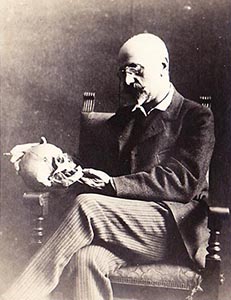
The Life and Times of Victor Karlovich Stember
1863 - 1921
Victor Karlovich Stember was a Russian portrait painter, born in Moscow on January 28, 1863, and died in Vladikavkaz on January 11, 1921, at the age of 58.
The Life and Times of Victor Karlovich Stember
Born: Moscow, January 28,1863
Died: Vladikavkaz, January 11, 1921 (Age 58)
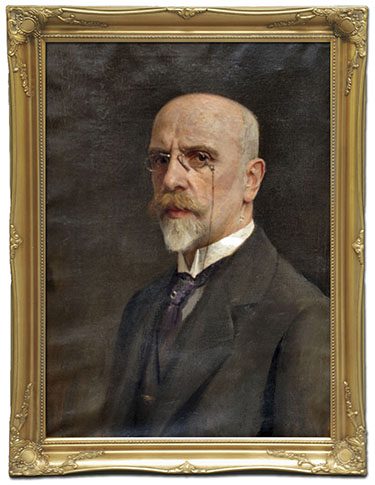
Victor Stember lineage is traced from 1720 to the present. The Stember's were originally from Kurliandia (now Latvia) and the Medtners from Eastern Prussia (Germany). The Medtners appeared in Moscow in the beginning of the 19th century while the Stembers arrived more towards the middle. They were then united in marriage to form one family.
Families formed include Mitchinson, Koltz, Zeidel, Saburov, Voinoff, Sokolov, Tülin, Zbruev, Sigoff, Tarassoff, Morian, Grorgievskaya, Apuhtin, Voeikov, Buhvostov, Goedike, Stephanov, and Volkov.
Victors parents were Karl Ivanoff Stember (1831-1888) and Emília Petrovna Medtner (1842 -1893). They lived in Moscow where Karl owned his own weaving factory. Karl converted the factory to steam power participating in the polytechnical exhibition of 1875. His title was first guild merchant.
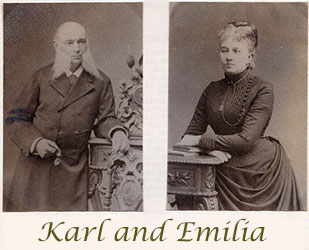
Toward the end of his life, Karl became a pioneer in the production of lace. He founded his own lace factory in a partnership with the Kovski brothers. Eventually he turned the business over to the Kovski brothers and became a director only.
Emília was born in Moscow and bore six children: Adolph, Emily, Victor and then a 12 year lapse before Alfred, Sophie and Konstantine. They lived in Sokolniki (a suburb of Moscow) on Alexeevskay Street behind the monastery. Victor had a very happy childhood playing in the Sokolnichy Forest where he developed his love of nature and eventually lead to his interest in landscapes.
Victor attributes his "rapturous feelings toward poetry and artistic urge for perfection and the feeling of endless beauty in nature" from the boarding school he attended in Tureika at the Nordt Boarding school. After completing the curriculum there, he returned to Moscow to attend the school of the Lutheran Church of Saint Michael. Here Victor spent much of his time playing violin and drawing, preparing to become an architect.
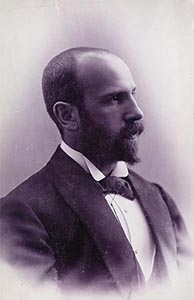
To study architecture, Victor attended the St. Petersburg Academy of Art. However, he was soon convinced that his destiny was to become a painter and persuaded his parents to allow him to study painting for the next three years.
In 1885, Victor moved to Paris to perfect his painting skills. He associated himself with a club of Russian artists where he was well received, but it was the "Atelier de Robert Fleury" which he joined that added a "specific French elegance" to his painting.
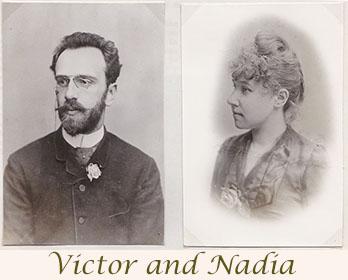
A year later Nadia Georgievskaya arrived in Paris with the goal of becoming an opera singer. Victor and Nadia met at the boarding house where they both lived on Rue Victor Hugo near Boi-de-Bolgne which is where Stember would set up and paint. Her singing was much acclaimed, but as time went on they fell in love. Nadia was conflicted between pursuing her own career or supporting Victor in his. The painter Bogolubov spoke to Nadia and convinced her that as beautiful as her voice was, in two decades her voice would be gone and lost to the world, but Victor's paintings would carry on for generations. She then decided to contribute to further development of his great talent instead of hers and they were married in Nice, France in 1888.
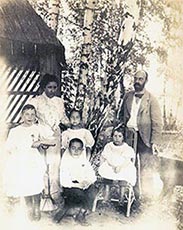
After painting in Nice for a couple years, they returned to Russia in time for the birth of the first of their five children: Ksenia (died of diphtheria at age 5), Natasha, Kolya, Nadia and Sonya.
In 1890, the family moved to Moscow and lived there where Victor painted many brilliant portraits of royalty including Tsarevich Prince Nicholas (future Czar) and Grand Duchess Olga Alexandrovna Romanoff (Czar's sister), and other famous people. One reason for this was undoubtedly because of his association with Boris Pasternak. On page 11 in the book "Boris Pasternak: A literary Biography" Volumes 1 and 2 by Christopher Barnes (20043 Cambridge University Press) Barnes states:
'In a different medium, Pasternak also assisted in creating sets for Arensky's new opera Raphael. A further lucrative sideline during his early years in Moscow was the offering of art instruction to various individuals, including some relatives of the prominent lawyers Garkavi and Shaikevich. Such was the success of this that he and his colleague, Viktor Shtember, eventually set up their own private art school. New social contacts brought an increasing flow of portrait commissions, and also invitations to Prince Golitsyn's, where interesting models were provided and high society regularly came to observe the various artists at work.'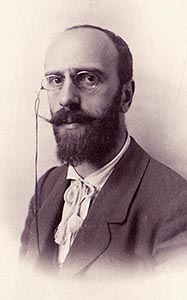
Sometimes Stember bartered his paintings for services the family needed. In his wife's memoirs, Nadja wrote: 'when the children reached school age, we found oursleves facing the question - how shall we afford the cost of tuition? In Russia, there was no free public education....but our problems were solved by Victor himself: Natasha at the age of 12 was admitted into the institute of her majesty Empress Maria. In exchange for the portrait of her majesty, painted by Victor for the main recreation hall of that institute, Natasha recieved a whole course of education. Same happened when the time came for Kolya, Nadja, and Sonya to go to school. They all went to the conservatory where Victor painted 3 portraits.'
In 1908, Victor moved his family to St. Petersburg and painted many notables including Anna Pavlova, Count Sheremetev, his wife and son, Prince Yusupov and both his sons.
In 1913 Victor celebrated the 25th anniversary of his artistic career by opening an exhibition of his canvases. Numerous admirers attended including Peter Carl Fabergé (pictured here standing directly behind Stember).
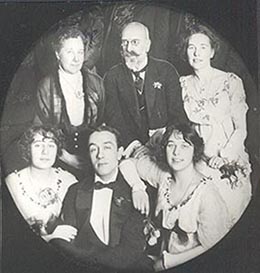
The difficult times of the communist revolution lay ahead for Russia and the Stember family. These times are chronicled in the diary written by Victor of the last three years of his life. He tragically died of pneumonia on January 11, 1921 in Vladikavkaz. He is buried in Nahichevan Russia.
His grave is located in the military cemetery. "from the main gate take 50 steps to the right by the road. The grave is marked with a metal cross and was framed by planted periwinkle."